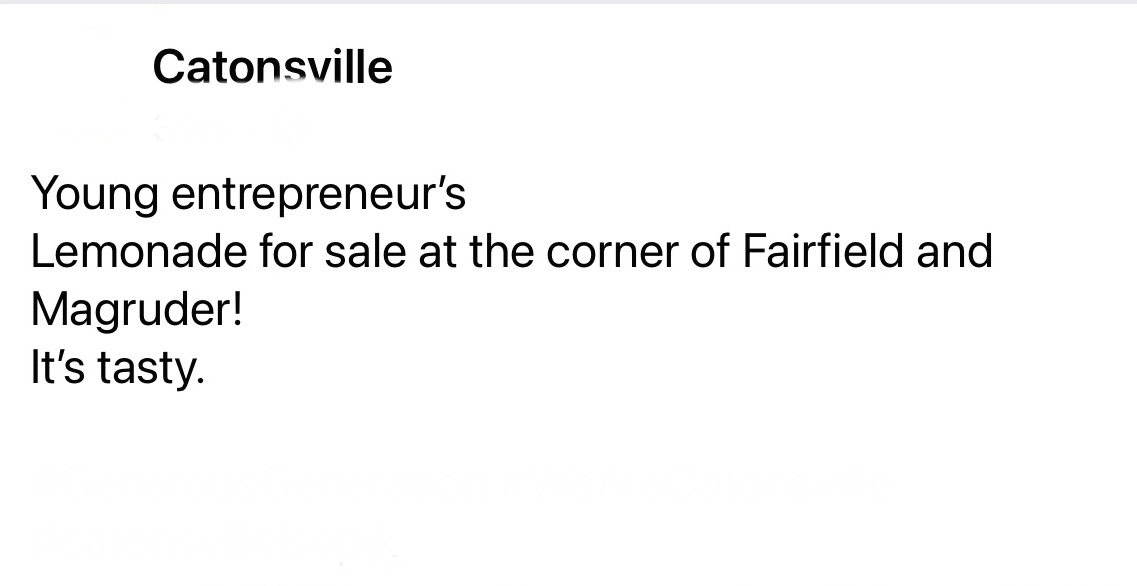
The Lemonade Stand Kids


What could be a more quintessential sign of suburban summer than a lemonade stand? Even if we drive by in a hurry, we smile at the sight of one. We remember carefree days of our own childhoods. If we do stop we usually put more money in the till than they are asking, especially if it’s for a charitable cause.

I, too, have gotten home from a drive and posted the location of a lemonade stand on social media to try to drum up more business for them. It’s almost as though there’s something precious about this occurrence. I feel an inner responsibility to help preserve it. 

So many things that children used to be able to do independently are now gone. 

The lemonade stand is a reminder of all those other things we used to do on our own, without parental supervision and hovering. If it disappears then all of that golden magic of our childhoods is gone forever. Once we were that eager child hoping to make a sale for the sheer fun of it. Now we want to enter into that joy as the smiling adult, full of appreciation and enthusiasm for a cold drink on a hot day, and for the children themselves.

I’ve been thinking a lot about how we love our lemonade stands in Columbia/HoCo and what a stark contrast there is in attitudes towards the young entrepreneurs in Baltimore City who turn up every day to wash windshields*. In fact, I’ve seen some people get outright angry at even the use of the term “young entrepreneurs.” Their brains will allow only one definition for the squeegee kid: criminal. 

I’ve read of communities rising up to support local kids whose lemonade stands ran afoul of permitting laws. It’s interesting to note that in these cases the police are called “over-zealous”. The children are not called “criminals”, even though they were (albeit unknowingly) breaking the law.

“Ah, but it’s different!” you may say, and I’d agree. There is a very big difference between the Lemonade Stand Kids and the Squeegee Kids. 

The Squeegee Kids really, really, really need the money. They do this not for fun, but for survival.

So, indulge me for a moment. Imagine a world where every driver greeted those young people with the appreciation and enthusiasm that they extend to the Lemonade Stand Kids.

Hear me out. 

Imagine parents making sure they always had a dollar in their car so their eager child could hand it to the young man and get a high five. Imagine feeling an inner happiness as you pulled up to the intersection and rolled down your window to say “good morning”, and “thank you” for a clean windshield. Imagine how that brief human interaction could brighten your day and theirs.

This is absolutely possible and the only thing it would take is a change in attitude. From us.

Doing these things would not make the squeegee kids disappear. It would make them wanted. It would make them valued. Can you imagine how that would impact their daily lives? If you can’t, think of the faces of children when you have stopped to make a purchase at a lemonade stand. They are filled with the expectation of good.

Now think of what a gift that would be to young people who turn out day after day on the street corners of Baltimore to wash windshields. It would be life changing, and not just for them. It would change us, too.We would begin to see squeegee kids the way we see our neighborhood children as they play at being shopkeepers: human, precious, full of potential. 

That gradual change in attitude could begin to change many other things.


*I’ve written about this recently (“Symptoms”) 


Comments

Popular posts from this blog

Teacher Gifts

Today is the last day of school before the Winter Break. It’s a good time to remember the far-reaching nature of our public school system. You may not have children. You may have sent your children to independent schools. It matters not. You will be impacted one way or another. Yesterday I read a long thread on Facebook about several waves of illness in the schools right now. There’s influenza A and norovirus, I believe. And of course there’s COVID. Apparently in some individual schools the rate of illness is high enough for school admin to notify parents.  When I was little the acceptable holiday gift for a teacher was one of those lovely floral handkerchief squares. (I don’t know what it was for male teachers. They were rare in my elementary years.) These days the range of teacher gifts is wider and I have fond memories of Target gift cards which I have written about before. I think it’s safe to say that giving one’s teacher Influenza, norovirus, or COVID is not the ideal holiday...

They Can Wait

This is not a typical Saturday post. That’s because, in my community, it’s not a typical Saturday.  Oakland Mills High School, after years of deferred repair, needs massive renovation. It’s pretty simple: when you don’t fix a problem it gets bigger. The school system itself said the the OMHS school building was  "no longer conducive to learning" back in 2018.  2018 .  But Thursday the Boad of Education voted to push it out of the lineup of important projects which will be given the go-ahead to proceed soonest.  In my opinion it’s a terrible decision and sets a dangerous precedent. To explain, here’s the advocacy letter I sent in support of Oakland Mills High School. I was rather proud of it. I am writing to ask you to proceed with needed renovation at Oakland Mills High School in the most timely and comprehensive manner humanly possible. I have read the letter sent to you by the Oakland Mills Community Association and I am in complete agreement. You are extremel...

Separate and Unequal

  Remember “Separate but equal”? Remember how that really meant that Black schools languished in  broken-down buildings without adequate heat or toilet facilities, with cast-off, ragged learning materials, underfunded and largely ignored? The Supreme Court struck that down in 1954. The evidence was clear that separate was not equal. Plessy v Ferguson had led to - - no, endorsed - - deeply unequal schooling and opportunities. We tend to think of Brown v Board as being purely about racial integration. It was not.  It was about the logical consequences of segregation. And they were not, not, not equal. The ruling in 1954 didn’t transform public education for non-whites into a land of milk and honey by any means. But it articulated some essential truths in a way that made including everyone a legal precedent which could be relied upon and built upon. It was better than what came before it but it rested upon unsteady ground. It did not necessarily change the hearts or minds ...