
An Important Reminder


Sometimes, when I have difficulty centering myself enough to find a blog topic, I find myself reading the obituaries in the Baltimore Sun. Today is one of those days. May I commend to you the life of Daniel Finkelstein.

Daniel Finkelstein, an ophthalmologist and medical ethics specialist, dies  Jacques Kelly, Baltimore Sun
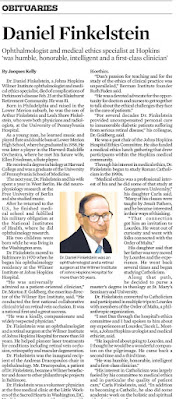


Screen shot from digital edition of the Sunday Sun


Dr. Finkelstein began his life in Philadelphia. Both of his parents were doctors. What came next in the narrative of his life is what caught my eye: 
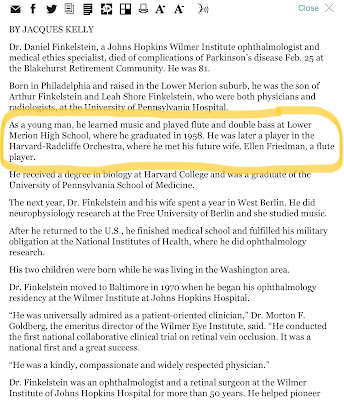


As a young man, he learned music and and played flute and double bass at Lower Merion High School, where he graduated in 1958. He was later a player in the Harvard-Radcliffe Orchestra, where he met his future wife, Ellen Friedman, a flute player.

Flute and double bass. There must be an interesting story behind that.

I’ve selected Dr. Finkelstein’s life story today because it reminds me of how previous generations believed that the both the study of music and the enjoyment of music were valuable parts of a well-rounded life, no matter what field of study one eventually decided upon for a career. Music was considered an important ingredient, a good use of one’s time and efforts.

In recent years I’ve seen misguided parents and sometimes even well-meaning school admin steer students away from music courses in the name of making them “better prepared” and “more attractive to” colleges. We seem to have lost the understanding that music can be an integral part of the cognitive and social emotional development of a human being. 

From my post on the Music and Memory Project:

Look at all the areas in our brains that music can "quicken": hearing, visual, emotional, motor...So, in education: music can be the oxygen which allows the strictly cognitive paper and pencil work to "breathe" into the student and be meaningfully retained, the leavening which allows the learning process to rise, the glue that makes the learning stick. “What Henry Knows”, Village Green/Town², August 13, 2014)

March is Music in Our Schools Month. I have a little something up my sleeve to share with you. (More news on that soon.) Reading about Dr. Finkelstein’s fascinating life reminded me how important it is to stress that music isn’t just for the professionals. It’s for everyone.

So, the thing about Music in Our Schools, the thing that matters most in the long run:  music in our schools never stays just in our schools. Music stays in our heads, in our hearts, in our lives. Music improves our quality of life. Music helps people build relationships with one another. Like Dr. and Mrs. Finkelstein. 

And music goes out into the world to be shared. 


Comments

Popular posts from this blog

Teacher Gifts

Today is the last day of school before the Winter Break. It’s a good time to remember the far-reaching nature of our public school system. You may not have children. You may have sent your children to independent schools. It matters not. You will be impacted one way or another. Yesterday I read a long thread on Facebook about several waves of illness in the schools right now. There’s influenza A and norovirus, I believe. And of course there’s COVID. Apparently in some individual schools the rate of illness is high enough for school admin to notify parents.  When I was little the acceptable holiday gift for a teacher was one of those lovely floral handkerchief squares. (I don’t know what it was for male teachers. They were rare in my elementary years.) These days the range of teacher gifts is wider and I have fond memories of Target gift cards which I have written about before. I think it’s safe to say that giving one’s teacher Influenza, norovirus, or COVID is not the ideal holiday...

F ³: We Are Not Entitled

  A college student went missing. His family and friends were distraught. The community was encouraged to be on the lookout and spread the word.  Days passed.  They must have been agonizing days for those who cared about the missing student. Thoughts that foul play had been involved cannot have been far from their thoughts.  Then, at last, the student was found. Alive. The news was shared with the public.  So. Much. Relief. A family had been reunited with their child. Even though we know that life is complicated, I think it is okay to accept this as a happy ending and leave it at that.  But the world of social media says no. For every expression of joy at the news came questions and even judgement. It became clear to me that some folks felt entitled to an explanation. They wanted the backstory. It’s as though they felt that, by enlisting the help of the public on social media, the authorities now owed them all the details. Television dramas often weave curr...

Separate and Unequal

  Remember “Separate but equal”? Remember how that really meant that Black schools languished in  broken-down buildings without adequate heat or toilet facilities, with cast-off, ragged learning materials, underfunded and largely ignored? The Supreme Court struck that down in 1954. The evidence was clear that separate was not equal. Plessy v Ferguson had led to - - no, endorsed - - deeply unequal schooling and opportunities. We tend to think of Brown v Board as being purely about racial integration. It was not.  It was about the logical consequences of segregation. And they were not, not, not equal. The ruling in 1954 didn’t transform public education for non-whites into a land of milk and honey by any means. But it articulated some essential truths in a way that made including everyone a legal precedent which could be relied upon and built upon. It was better than what came before it but it rested upon unsteady ground. It did not necessarily change the hearts or minds ...