
Sticks, Leaves, and Touching Grass


After yesterday’s post you might be surprised to see this photo of students tackling a math problem.


Image from Glenwood Academy. Used with permission.

Take a closer look at the math problem.


They’re making “Stick Stew.”

Measuring, doubling, and halving ingredients for our 'Stick Stew'. Even basic recipes require math skills. Making recipes larger or smaller can take you even deeper into fractions, multiplication, and division! - - Glenwood Academy

As someone who had terrible experiences with math throughout my education, I thought, “Wow! That looks like fun!” 

As a career early childhood educator, I wondered, “But did they really get to go out and make ‘Stick Stew’ with real sticks?”

Glenwood Academy is described on the The Maryland Association of Nonpublic Special Education Facilities (MANSEF) website as follows:

GA embraces and empowers all students with language-based learning differences such as dysgraphia, dyscalculia, dyslexia, and language processing difficulties. Through an engaging, multi-sensory, developmental, language-intensive curriculum, we work towards helping all of our students to evolve and discover his or her individual potential for greatness.

What caught my eye, of course, was the engaging presentation of the math lesson. What sparked my imagination was the potential for a multi-sensory experience with sticks and leaves. I don’t know if this particular lesson culminated in a hands-on nature experience, but GA’s social media posts document a curriculum filled with “engaging, multi-sensory, developmental, language-intensive” learning experiences.

Around the same time that I was contemplating this photo, I came across a quote from Chiara D’Amore, founder and CEO of the Community Ecology Institute:

At heart, I am an experiential environmental educator. I love little more than getting folks out into nature and helping them learn about why and how we should care for the ecosystem of which we are a part and on which we ultimately depend. And the true joy it brings people, especially in an age in which we spend so much time inside on screens, is some of the best medicine.

D’Amore illustrates this statement with photographs taken while engaging with students in CEI programs.
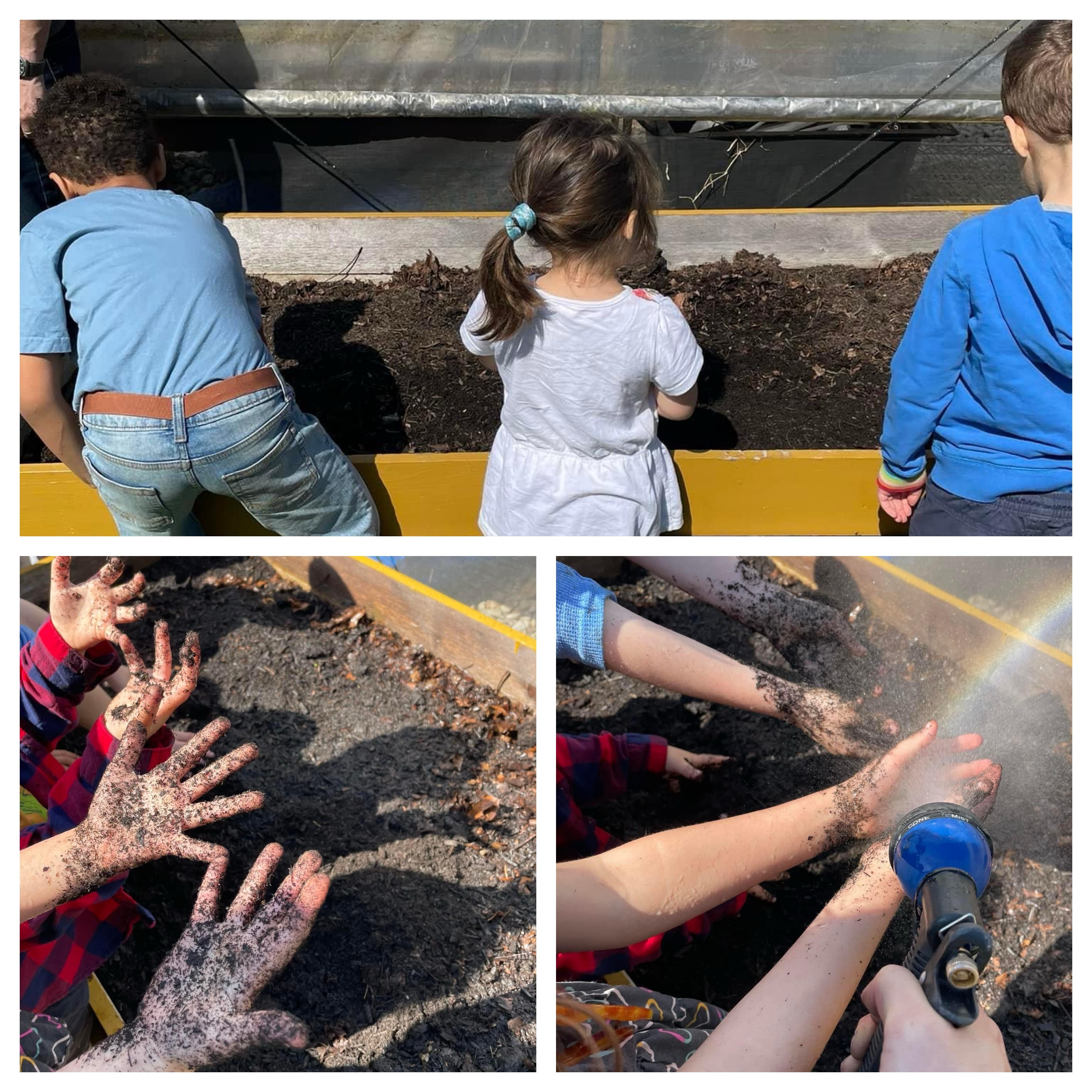


Images: Chiara D’Amore, used with permission 

And here’s how CEI describes its overall program goals: 

We create innovative, meaningful experiential education programs for people across the lifespan.

Although the missions of these two institutions may be quite different, I couldn’t get the juxtaposition of the two experiences out of my head. Both use materials from the natural world as a jumping off point. 

Clearly the Glenwood Academy’s example is more symbolic, using the mental image of Stick Stew to enliven a lesson in recalculating amounts in a recipe. D’Amore’s heartfelt description of CEI’s experiential learning in nature speaks to the discovery learning experiences that I’ve always loved the most in teaching early childhood classes.

Both illustrate ways in which traditional classroom education isn’t the only way to learn deeply and effectively. And also, that hands-on experiential learning isn’t just for “the littles.” 

Yesterday a response from a reader reminded me of the challenges presented by non-traditional learning environments.

To make project-based and inquiry learning possible, we have to slash our class sizes.

It’s true. These experiences rely on smaller groups, more adult-to-student interaction and relationship-building. That’s expensive. We keep hearing that our school systems can’t afford that.

Nevertheless, I’m writing about this here because I’m convinced that we need to find ways to incorporate these kinds of experiences into our kids’ lives. Not solely to support educational goals, but also, as Dr. D’Amore says:

…the true joy it brings people, especially in an age in which we spend so much time inside on screens, is some of the best medicine.

What do you think?


Comments

Popular posts from this blog

Teacher Gifts

Today is the last day of school before the Winter Break. It’s a good time to remember the far-reaching nature of our public school system. You may not have children. You may have sent your children to independent schools. It matters not. You will be impacted one way or another. Yesterday I read a long thread on Facebook about several waves of illness in the schools right now. There’s influenza A and norovirus, I believe. And of course there’s COVID. Apparently in some individual schools the rate of illness is high enough for school admin to notify parents.  When I was little the acceptable holiday gift for a teacher was one of those lovely floral handkerchief squares. (I don’t know what it was for male teachers. They were rare in my elementary years.) These days the range of teacher gifts is wider and I have fond memories of Target gift cards which I have written about before. I think it’s safe to say that giving one’s teacher Influenza, norovirus, or COVID is not the ideal holiday...

They Can Wait

This is not a typical Saturday post. That’s because, in my community, it’s not a typical Saturday.  Oakland Mills High School, after years of deferred repair, needs massive renovation. It’s pretty simple: when you don’t fix a problem it gets bigger. The school system itself said the the OMHS school building was  "no longer conducive to learning" back in 2018.  2018 .  But Thursday the Boad of Education voted to push it out of the lineup of important projects which will be given the go-ahead to proceed soonest.  In my opinion it’s a terrible decision and sets a dangerous precedent. To explain, here’s the advocacy letter I sent in support of Oakland Mills High School. I was rather proud of it. I am writing to ask you to proceed with needed renovation at Oakland Mills High School in the most timely and comprehensive manner humanly possible. I have read the letter sent to you by the Oakland Mills Community Association and I am in complete agreement. You are extremel...

Columbia Chance Connection

  Last night, as my husband and I were about to sit down to dinner, our front door swung open and a cheery voice announced, “I’m ba—ack!”  We weren’t expecting anyone. Clearly the only people who’d walk right in to our house would be one of our offspring. I had my reading glasses on so I wasn’t seeing too clearly. It seemed too tall for our youngest, but we knew our eldest was at work. I took off my glasses to see a friendly but confused face scanning our living room. When her gaze landed on us we all had a sudden realization. We didn’t know eachother. “Oh I’m so sorry! I’m in the wrong house! My daughter just moved in and she needed hooks for the kitchen so I ran out to get them.” She waved the package. “All these houses look the same and I don’t know the neighborhood yet. I thought this was my daughter’s house.” We were all getting a bit giggly. “That’s okay. For a quick second we thought you were our daughter,” said my husband. I told her our names and said she should defin...