
You’re invited to a Five-Star Soirée!
Those words caught my eye as I scrolled through Twitter last week. Was it a glamorous fundraiser for a good cause? Not exactly.

Calling all #realtors in the Baltimore area! Miller & Smith is excited to host an #openhouse at their new Multi-Generational home in Ellicott City this Saturday. RSVP now!
#newconstruction #EllicottCity #multigenerationalhomes
It was an announcement for what I guess would be called a broker’s open house in a development called Patapsco Crossing. The developers, Miller and Smith, were hoping to draw in an enthusiastic crowd of real estate professionals to experience the feel of their Bradburne Multigenerational house model.

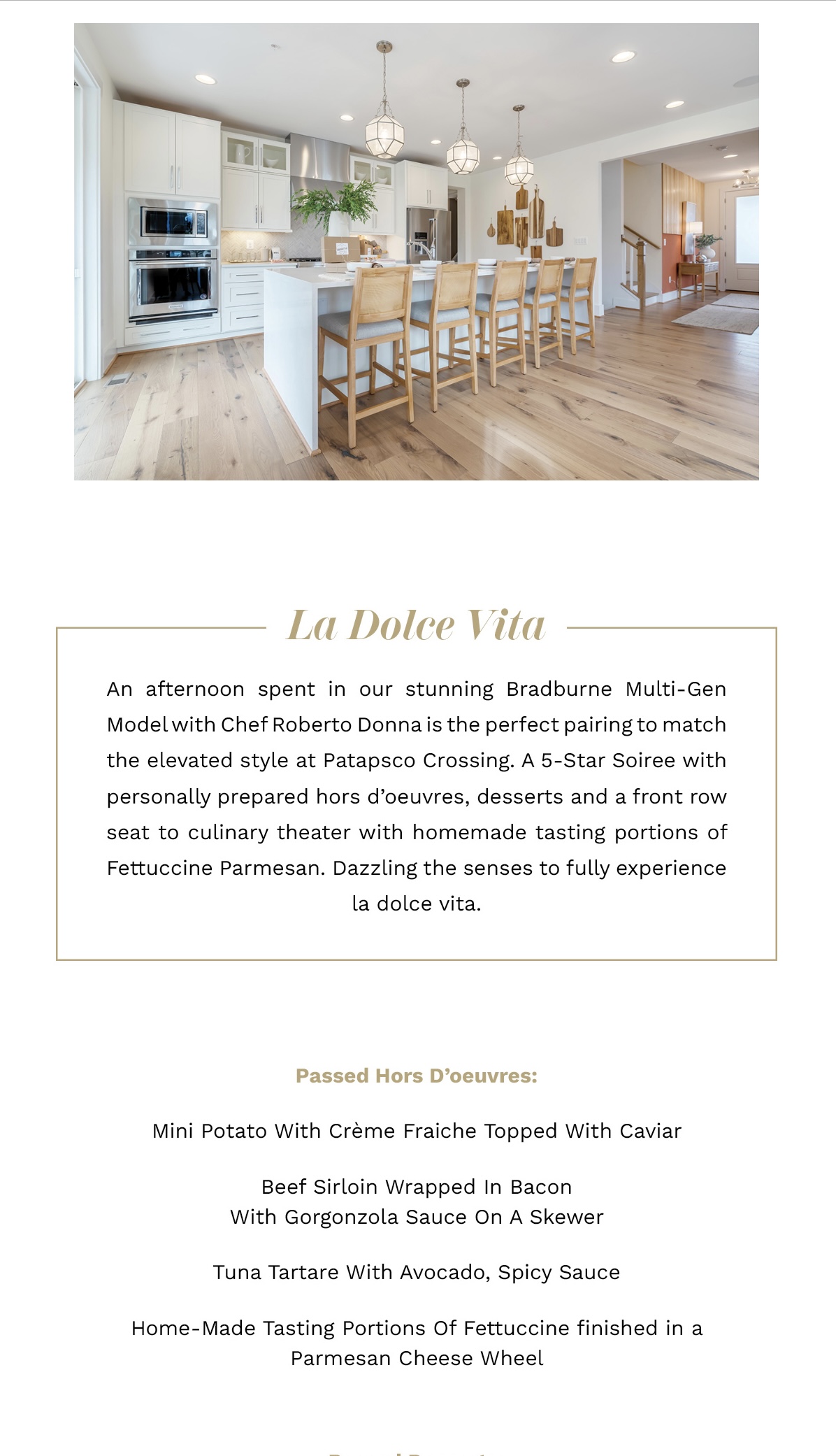

If I were more familiar with the real estate business, I would know whether an event like this is over the top or par for the course. It made me wonder if real estate brokers have become such a jaded lot that one must bribe them to invest their time with culinary notables and beef sirloin wrapped in bacon.
If you know more, please enlighten me.
Although it was the fanciness if the invitation that grabbed my attention, it was actually one simple word that convinced me to write about it.
Multigenerational.
Is multigenerational housing becomeing a “thing” in the world of real estate? And how does this differ, real estate-wise, from homes that come with a built-in Mother-in-law suite?
I have several thoughts about this. One is that the first thing I thought of when I read the word multigenerational was The Waltons. After that it was a quick mental step to imagining what the end of day routine would sound like at the Bradburne in Patapsco Crossing.
My vision of multigenerational living is of families who live together by virtue of necessity, in whatever home that is available to them. Buying million dollar homes? Not so much. Perhaps that is because I see it as coming from a lack of overall financial resources which prompts families to share a variety of resources (financial and otherwise) to support the larger family unit.
This isn’t necessarily so.
While I was raised to expect that a home would contain the so-called nuclear family, many other cultures view multigenerational living as the norm. And my initial assumption - - that it is prompted by a lack of financial resources - - is far from true in many cases. The ethnically diverse nature of Howard County may mean that more home buyers are seeking a house that is set up to meet those needs that I had realized.
I did go Google-hopping to see if I could see signs of any larger trend in multigenerational living. Apparently there is.
One secret more working parents are discovering: Multigenerational living, Allaya Cooks-Campbell, BetterUp.com
Already common in some cultures and countries, multigenerational living is on the rise in others. Only 12% of American adults lived in a multigenerational home as of 1980. Four decades later, that percentage has more than doubled, to 26%.
Why the rise? There are practical reasons for multigenerational housing. Most people choose to live together for financial reasons and caregiving at first. For those working adults feeling the pressures of balancing career with caregiving, the high cost of housing and difficulty of arranging for convenient and high-quality care — for children or aging parents — are contributing factors.
Eventually, they find that there are mental and emotional benefits to multigenerational living as well.
I guess it depends on your family. Not everyone was cut out for the emotional dynamics of multigenerational living. And, in the case of Patapsco Crossing, it also depends on your pocketbook. Having always been a teacher (and married to one) my world does not include the possibility of houses in the million dollar range. Clearly HoCo’s high concentration of residents who are in highly-compensated professional careers makes such offerings worthwhile for real estate developers.
They wouldn’t be putting it out there if they hadn’t carefully researched the market first.
What do you think? Is multigenerational living coming back? Can you imagine doing it? Are you doing it already? Could the American view of the nuclear family be shifting?
Also, are there a lot of these Five-Star Soirées out there in the world of real estate? I’m still rather stunned by that.
Comments
Post a Comment