About a year ago I was looking for a photo online and I discovered it had disappeared.
Erased by Whiteness, March 16, 2021
It disappeared.
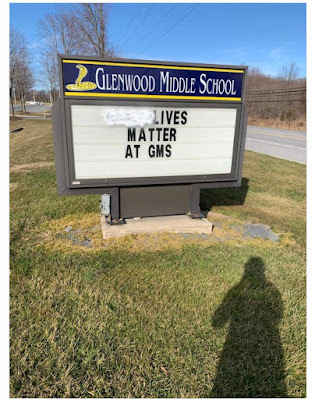
I went to the Facebook page to find the photograph of the racist vandalism at Glenwood Middle School and, as I was looking at it, a message popped up:
This photo is no longer available.
And, just like that, the photo disappeared.
Boom.
That was weird.
Howard County police investigating racist vandalism at Glenwood Middle School, Jacob Calvin Meyer, Baltimore Sun
This is the photo. Someone sent it to me in response to my post.
I had the same sort of feeling when I saw the results* of the most recent Goucher Poll. A question to respondents about top priorities for state government yielded these results:
- public safety 25%
- education 17%
- economy/jobs 14%
- health care 11%
- enviro/climate 8%
- housing/community devpt 7%
- transpo/infrastructure 7%
- racial/social justice 6%
There it is at the bottom, so small you almost can’t see it. Racial/social justice clocks in at just six per cent. Public safety leads the pack at twenty-five per cent.
It’s simply mind boggling. Maryland and the nation have come face to face with so many blatant examples of harmful, race-based actions and decisions in the last eight years. But when it comes down to it, these poll respondents appear to have processed it all through a lens of “public safety.”
I wonder why.
Throughout his years as Governor, Larry Hogan has framed almost everything to do with Black residents of Maryland in terms of crime. Black elected officials are deemed unworthy and/or untrustworthy, Black neighborhoods are described as crime-infested, projects that would bring greater prosperity and opportunity to Black communities are rejected as a waste of money. In public statements, off-the-cuff quips, and in public policy Hogan has blamed and othered the Black Marylanders whom he ought to be representing fully and without prejudice.
But we can’t blame this all on Governor Hogan. People had to be willing to take the bait. And they have. Time and again Hogan’s poll numbers show that his brand of dog-whistle politics is not a dealbreaker for Marylanders. This most recent poll is no exception, showing an approval rating of sixty-five per cent. This continues to floor me.
Look at the first seven topics covered in the poll question about priorities: public safety, education, economy/jobs, health care, environment/climate, housing/community development, transportation/infrastructure. In Maryland (and nationally) outcomes for every single one of these categories are reduced for Black and Brown residents because of the absence of racial/social justice. Envision racial/social justice at the center with all the other categories at the end of spokes like a wheel.
It’s all interconnected.
But that’s not the picture people want to see, apparently. They may have their moments of being concerned about racial injustice but it doesn’t last. I don’t know whether it’s just too uncomfortable or whether concern for their own priorities wins out despite moments of empathy or compassion.
Empathy and compassion say: justice. But whiteness says: public safety.
And the Goucher poll says whiteness is doing just fine.
* Truth in advertising: I found these numbers in a tweet by Pamela Wood of the Baltimore Banner.
Comments
Post a Comment