
The most important thing I could possibly write about today is the confirmation of Judge Ketanji Brown Jackson to the Supreme Court. It is also a task for which I am wholly unqualified.
I grew up in a white world that was white by design, although I didn’t know it. I had one Black teacher in elementary school. One Black student in my fifth grade class. No Black families in my neighborhood. I don’t think there were any Black shop owners or employees at the neighborhood shops. No Black librarians at the local library.
I had absolutely no idea that this was not normal, that it was contrived, and that my safe, protected suburban bubble was built on the exclusion of others.
It has become more and more apparent in recent years that some people in this country are very sad to have lost that safe protected bubble and they think they have a right to it. On the other hand, they are extremely uncomfortable with any kind of journalistic reporting or educational curriculum which allows the truth of exclusion and injustice to be seen. Their protected bubble has room for better homes, better schools, better opportunities and better health care but it does not have room for the truth.
Of course it is wrong to cling to one’s privilege by leveraging its power to harm and disenfranchise others. It’s also poisonous to everyone involved and, dare I say, it’s unAmerican. At least, it’s not who we *say* we are.
There is no good reason that there has never been a Black woman on the Supreme Court. There are a million bad ones. And, my observation of the Black women I follow on Twitter tells me that Black women are supremely tired of that. No, not tired.
Exhausted. Anguished. Demoralized. Heartbroken. Enraged.
One of the late Supreme Court Justice Ruth Bader Ginsburg’s most well known quotes is this:
Women belong in all places where decisions are being made. It shouldn't be that women are the exception.
As much as I agree with the sentiment, I find it telling that so many people can read that and that an image of a Black woman does not come to mind. If your world is white, your friends and neighbors are white, your church and coworkers are white - - if your protective bubble is white - - then that is your default. You don’t even imagine how it could be different.
This is not a chance to shake our heads sadly and say “oh, that’s too bad.” It’s absolutely at the root of significant ongoing palpable harm to Black Americans: in schools and neighborhoods, in the workplace, at the hands of the police, in employment and healthcare, in our legal system. As unqualified as I feel to write about it, this is by far the most important issue I will address in my lifetime.
I’ve used the following quote from Marian Wright Edelman in other posts:

You can’t be what you can’t see. - - Marian Wright Edelman, founder and President emerita of the Children’s Defense Fund.
Every place we look in our lives, every single moment, is an opportunity for the world to be transformed by inclusion. We can wrestle with our own shortcomings and actively seek those opportunities. Or we can stay in our safe and protected bubbles and pretend that some people are just invisible to us. Or that someone else will fix it.
Remember: what feels safe to us is violence to others.
I’m going to close by amending Justice Ginsberg’s quote to remind myself and my readers that today is a good day to believe and advocate for this:
Black Women belong in all places where decisions are being made. It shouldn't be that Black women are the exception.
What a joyful day it was to observe the confirmation of future Justice Ketanji Brown Jackson. Let’s make it our mission to invite, support, and work for more days like that.
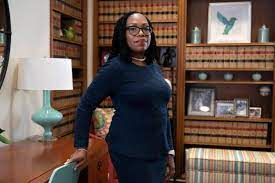
Photo from Baltimore Sun, Jacquelyn Martin/AP Photo
Comments
Post a Comment